BUILD · BRAND WEB PRESENCE ENGINE
Turning “good SEO” from an opinion into a scored, sourced standard
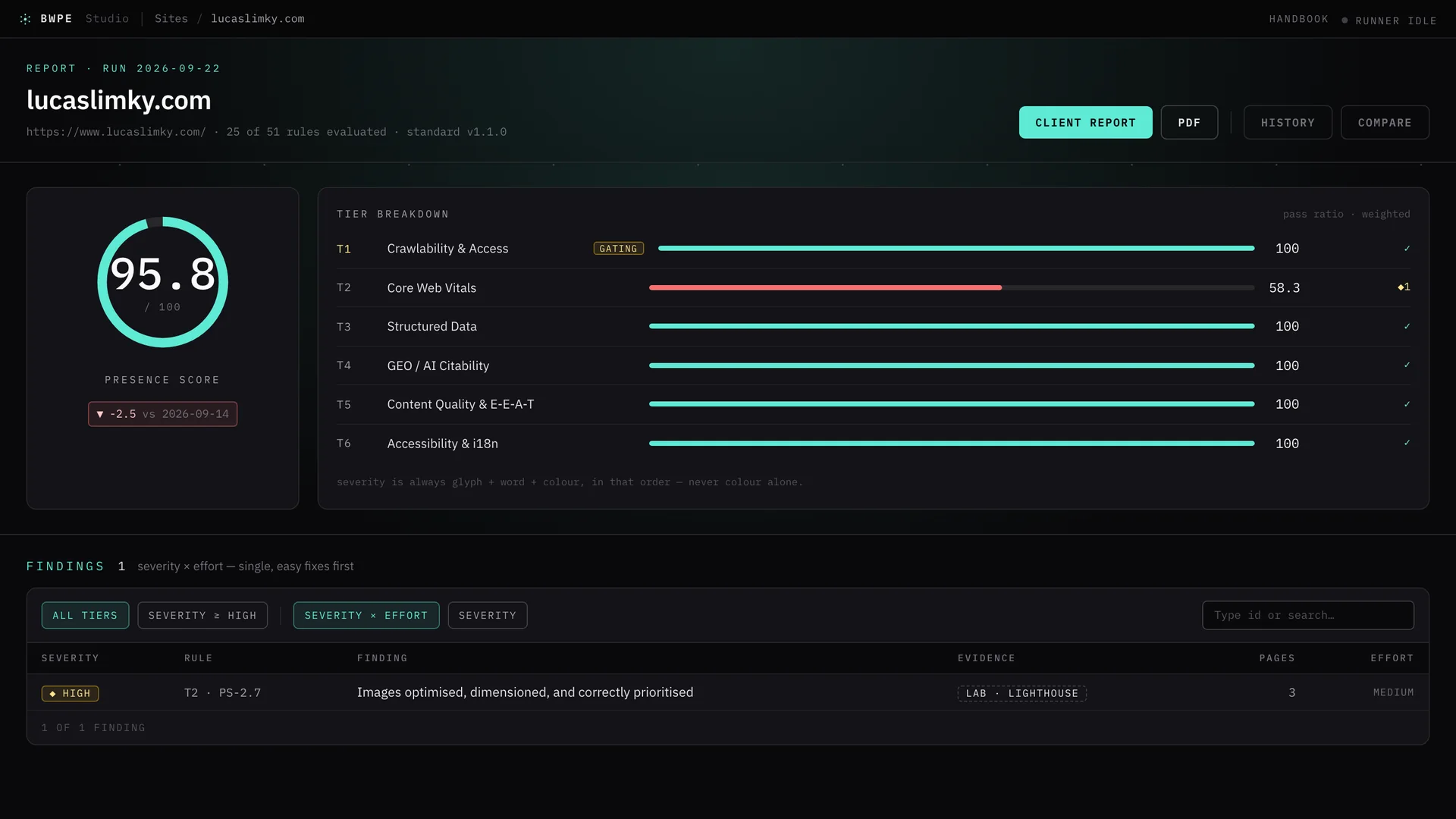
Every SEO recommendation is somebody's opinion until it carries a citation. BWPE is my attempt to fix that for myself: a versioned rubric of 51 rules across 6 tiers, a CLI that audits any site against it and produces a client-facing report, and a generator that builds new sites against the exact same definition of good.
Personal build. All phases complete as of August 2026; standard at v1.1 since September 2026.
- 51
- rules in the Presence Standard, v1.1
- 6
- tiers, gated so foundations come first
- 2
- modes, audit an existing site, or generate one
- 1
- definition of “good”, shared by both
Why I built it
I kept giving the same advice to different sites and having no way to show what it was worth. A checklist in a doc drifts, ages badly, and can't tell you whether the site got better after you fixed things. The fix was to make the standard a file. One YAML rubric, versioned, with weights and severities, so an audit produces a number you can compare against last month's number, and so the generator and the auditor can never disagree about what they're aiming for, because they read the same file.
How it scores
Presence Score = 100 × (1 − Σ failed weights ÷ Σ applicable weights). Applicable is the operative word: a rule that doesn't apply to a site doesn't quietly count against it. The six tiers are gated, so a site failing the foundations doesn't get flattered by points earned further up. A great answer-engine story is moot if the page doesn't render or can't be crawled. Each run writes an operator-facing Markdown report, a machine-readable snapshot for longitudinal diffing, and a client-facing HTML report plus PDF. There's a `diff` command specifically so 'is this better than it was' is a command, not a memory test. The standard moved to v1.1 in September 2026 with a 51st rule: a restaurant's menu has to exist as real, crawlable HTML text somewhere on the site, not only inside a PDF download or a photograph, because a listing an answer engine can't read is a listing it can't cite. The check was built entirely from fields the crawler already extracted, and on the first two live sites it correctly reported 'not checked' rather than guessing a verdict on messy real-world menu markup.
The honesty contract
This is the part I'm proudest of. Every rule carries a `source` and an `evidence_class`. A rule whose claim can't be traced to a real, checkable authority is marked unverified with a note saying what it actually is, and only rules backed by a controlled study or vendor documentation may be presented to a client as established fact. Everything else is labelled house opinion in the deliverable. Each rule also carries the date a human last confirmed it still holds, not the date it was written. This field deprecates fast, so quarterly review is a named commitment rather than a good intention. And the client report itself is audited against the standard's own accessibility tier before any run reports itself done. If the tool can't pass its own bar, it doesn't get to grade you.
The generate side
Mode B goes the other way: ingest a brand's palette and typography into a structured brief, lint the brief, and only then template a Next.js generation kit and an SEO kit from it. There's a deliberate hard gate in the middle. The flag that authorises anything to leave the machine can only be set by a human editing the brief by hand. No command in the CLI and no button in the UI can set it. Automation that can grant itself permission isn't a gate.
What it proves
That I can hold a position on SEO and GEO and then show my work, including the places where the honest answer is 'this is a defensible convention, not a proven finding.' In a field where confident overclaiming is the norm, being explicit about evidence class is the differentiator.
Stack